How to buy fragrance without wasting money

I have bought perfumes because the bottle looked like architecture, because a reviewer whispered the word masterpiece, because the notes listed three things I already loved, and because the discount was going to disappear at midnight. The discount returned the following week. My money did not.
Blind buying is not always a disaster. Sometimes the parcel opens and angels appear. But it is a poor system for anyone who would be annoyed by a beautiful bottle they never reach for. A review can tell you what someone else noticed. A note list can tell you what the brand chose to name. Neither can tell you whether you will enjoy wearing the finished fragrance on an ordinary Tuesday, in your weather, on your skin, after the excitement has gone.
Before you spend, in one breath. Narrow before you browse. Blotters first, skin second, and only for the finalists. Wait a full day before deciding, then wear it again on another. Read reviews for repeated observations, not verdicts. And ask the one question that has saved me the most money: would I still buy this next month, at full price?
01Narrow first, then smell
The first mistake is beginning with a name. A famous bottle enters the mind already wearing lighting, music and other people's approval. Start with your life instead. There are more fragrances in the world than you could smell in a lifetime, and working through all of them is not curiosity. It is administrative punishment. Narrow first. Choose the climate you will actually wear the fragrance in. Choose the season. Then narrow by family, notes, concentration, price, or whatever genuinely matters to you. A hot-weather office scent and a cold-night dinner scent are different jobs, and there is no prize for interviewing every candidate.
Paper introduces you. Skin tells you whether you should exchange keys.
Blind buys fail for specific reasons. The opening may be glorious and the drydown irritating. A note you love in food may feel strange on skin. The fragrance may be louder, sweeter, quieter or more persistent than the review led you to imagine. You may admire it and still not want to smell like it. Most expensively of all, you may love the idea of the perfume more than the hours of wearing it.

This is why paper and skin have different jobs. Start on a blotter. Paper lets you compare several fragrances without committing your entire body to the experiment. Label each strip immediately. I will remember which is which is one of the small lies fragrance shops encourage us to tell ourselves. Smell the opening, put the strip down, then return to it later. The blotter is excellent for elimination: it exposes an accord you dislike, a sweetness that never lets up, or a structure worth taking further.
Then test the finalists on clean, unscented skin. Research has found that perfume can be perceived differently once it mixes with a person's own body odour, and that a preferred perfume tends to form a more pleasant blend with an individual's odour than a randomly assigned one. Laboratory work also shows that fragrance materials evaporate differently depending on the surface they sit on. In plain language, paper shows you the perfume in isolation, and skin tells you whether the two of you can live together. Do not spend full-bottle money on a blotter-only romance.
02Give it the whole day
The second mistake is deciding in the first ten minutes. Perfume is built from materials with different volatilities, so what reaches you first is not necessarily what remains. The opening is useful, but it is only the entrance hall.
The cheapest bottle is the one you did not need to buy.
My waiting rule is simple. At ten minutes, ask whether the opening still interests you once the first flash has passed. Notice anything sharp, syrupy, metallic, dusty, medicinal or unexpectedly familiar, and do not panic over one odd edge yet, because some openings are all elbows. At one hour, ask whether the fragrance has become more itself. This is where I start judging balance, texture, and the distance at which I enjoy it, and I smell my skin from normal conversational range before pressing my nose against it. A perfume is worn in air, not examined like evidence. At six hours, ask the expensive question: do I still want this around? You are not after a technical note recital. You are checking whether what remains feels comforting, tiring, dull, elegant, distracting, or quietly addictive, and whether you kept seeking it out or spent the day wishing for soap.
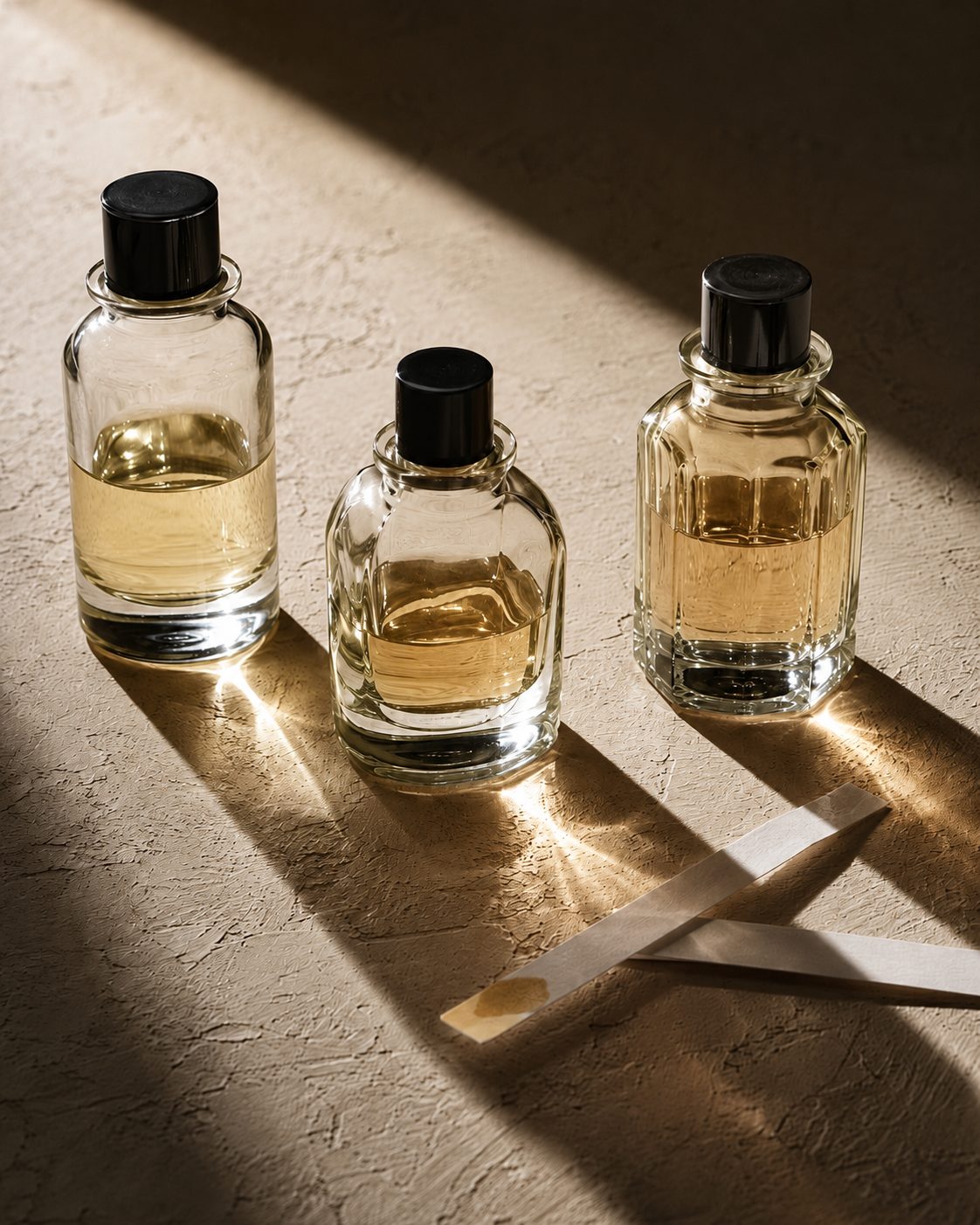
Wear the sample again on another day, in the setting you are buying it for. The office test should happen in an office, or something close to one. The summer test should meet real heat. The evening fragrance should survive an evening, not merely a brightly lit shop at lunchtime. One good wear can be chemistry, weather or mood. Two or three good wears begin to look like a relationship.

Your nose also needs mercy. Habituation is a genuine drop in responsiveness during continuous or repeated exposure to a smell, which is why the fifth strip can become less informative than the first even when the fifth perfume is excellent. So here is my non-sacred rule: three fragrances on paper, then no more than two on skin. If none of them earns the skin, leave. Do not spray seven more out of frustration. And do not put too much faith in the ceremonial jar of coffee beans, since a study comparing coffee, lemon and plain air found coffee did not actually improve fragrance identification. Fresh air and time are at least as defensible.
For samples, buy according to the size of the decision. A millilitre is enough for a first argument. Two or three millilitres gives several proper wears. Five to ten millilitres is for a fragrance you already like but need to test across weather, work, and the point where fascination turns to fatigue. These are not industry laws. They are cheaper stages of commitment. An official sample comes from the brand or an authorised retailer. A decant is fragrance transferred from a full bottle into a smaller vial. A split is a group purchase in which one bottle is divided among several people. All three are useful, and none requires you to pretend a tiny vial is glamorous. With decants and splits, buy the seller before you buy the scent: a consistent history, clear photographs, precise volume, the stated source of the bottle, secure packaging, and labels that will still make sense in three months. Ask how it was stored and when it was decanted, and be wary when the price is implausibly low or every hard question is met with a cloud of enthusiasm instead of an answer. Finally, apply anything unfamiliar sensibly. Certain fragrance ingredients can trigger reactions in sensitised people, so if a test irritates your skin, stop and wash the area. The goal is to save money, not to win a dermatological argument with your wrist.
03Read reviews, then interrogate yourself
Reviews are useful once you stop asking them to make the decision. Ignore the verdict first. Amazing, boring, beast mode and compliment magnet are conclusions with your nose left out. Look instead for repeated observations. Do several wearers mention a dry woody finish, a dense vanilla stage, a brief citrus opening, a smoky turn, or a close-wearing trail? Repetition does not make an opinion true for you, but it gives you something specific to test.
Read reviewers whose conditions resemble yours. Climate shapes how you experience and use a fragrance, which is exactly why narrowing by climate and season before you browse by name is worth the extra minute. A review written on a cold winter commute may not answer a question about August in Riyadh. Notice when the reviewer wore it, how much they sprayed, where they applied it, and what they normally enjoy. Without that context, lasts forever is barely a sentence. Use negative reviews especially well, because a complaint can be a recommendation in disguise. Too dry, too quiet, or too much incense may describe exactly what you want. The point is not to find consensus. It is to collect testable warnings.
Before paying, put yourself through a few honest questions. Do I enjoy the opening, the middle and what remains? Have I worn it for at least two ordinary days, not only during the thrill of shopping? Would I choose it if the bottle were plain and nobody online had reviewed it? Does it suit the climate, the setting and the frequency I actually have in mind? Do I want the full bottle, or do I merely want more than the sample? What will I wear less often if I buy this? And would I still buy it next month, at the normal price? That last question has saved me more money than any sale.
A full bottle should solve a problem a sample cannot. Perhaps you wear it constantly. Perhaps the small vial makes you ration something you genuinely love. Perhaps the bottle itself gives you pleasure, and you are honest that this is part of the purchase. All valid. What is not valid is buying a hundred millilitres because two millilitres made you briefly afraid of running out.

One last disclosure, since the whole point is your money and not mine. Nothing here is sponsored. No retailer, decant service or bottle paid to appear, and none has been named. The single purpose of this advice is to keep your money in your account until a fragrance has earned the right to leave with it. The best collection is not the largest one. It is the one with the fewest apologies.
Analysis drew on the Osmagora fragrance library.
Lenochova et al., 'Psychology of Fragrance Use', PLOS ONE, 2012.
Hadjiefstathiou et al., device for studying fragrance evaporation on skin and model surfaces, Talanta, 2025.
Sinding et al., 'New determinants of olfactory habituation', Scientific Reports, 2017.
Grosofsky, Haupert and Versteeg, on coffee and lemon scents in odour identification, 2011.
International Fragrance Association, 'Allergens'.
The Perfume Society, practical sampling guidance.