The climate problem nobody warns you about
You found it somewhere warmer than home. Perhaps at dusk, after a day when the pavement still held the sun. On the blotter it was radiant. On your skin it opened with a soft citrus shimmer, then settled into flowers, wood and something salted by the evening air. You bought the bottle. You carried it home. And there, under another sky, it became thinner, heavier, quieter, sharper, or simply wrong.
The easy explanations are not always the right ones. Your memory has not necessarily romanticised the holiday. The bottle has not necessarily gone bad. Often the liquid is substantially the same and the conditions around it are not. A fragrance is designed as a timed release of volatile materials. What you smell depends on which molecules leave the liquid and the skin, how quickly they enter the air, and how the mixture changes as each component disappears. Temperature, airflow, the application surface and the interactions inside the formula all affect that release. That is why a perfume can seem to change countries with you.
01The air changes the order of arrival
To smell a fragrance, part of it must become vapour. The materials do not rise together at one obedient speed. Each has its own vapour pressure, polarity, solubility, diffusion behaviour and odour threshold. Inside a mixture, the ingredients also affect one another, so a material that looks predictable alone may behave differently beside ethanol, water, resins, musks or other aroma molecules.
Heat accelerates the drama. As temperature rises, the tendency of volatile materials to enter the gas phase rises too. The first effect is often abundance. More of the bright opening reaches the air around you, so citrus, aromatic herbs, light fruits and transparent florals can feel larger and more immediate. The second effect is compression. Those highly volatile materials are spent sooner, and the heart and base can appear earlier than they did in a cooler place. The perfume has not skipped its structure, but the intervals between its movements may feel shorter. This is the part people describe as, everything arrived at once, then it disappeared. Strictly speaking, it did not all evaporate at the same rate. Heat altered the curve. It increased the early release, changed the balance in the air just above the skin, and moved the formula through its phases faster.
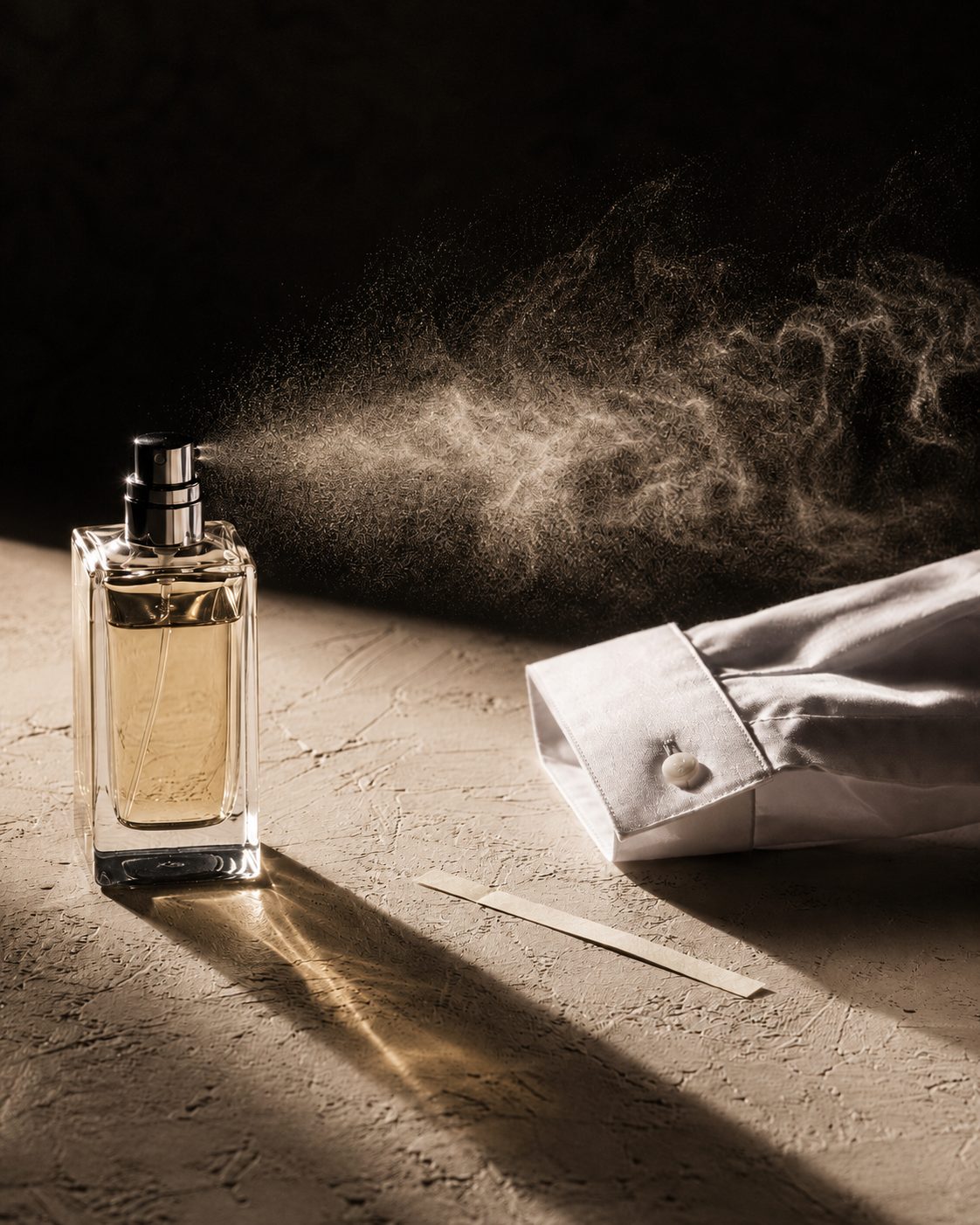
Cold produces the opposite problem. A fragrance that projected beautifully in warm air may become restrained, slow and close to the body. The volatile opening is released less aggressively. Dense woods, resins, musks and amber materials may still persist, but they can take longer to become legible. This is why long-lasting and noticeable are not the same quality. A material can remain on skin while releasing too little into the air to be clearly perceived.
A perfume is not only what is in the bottle. It is what escapes from it, where, and when.
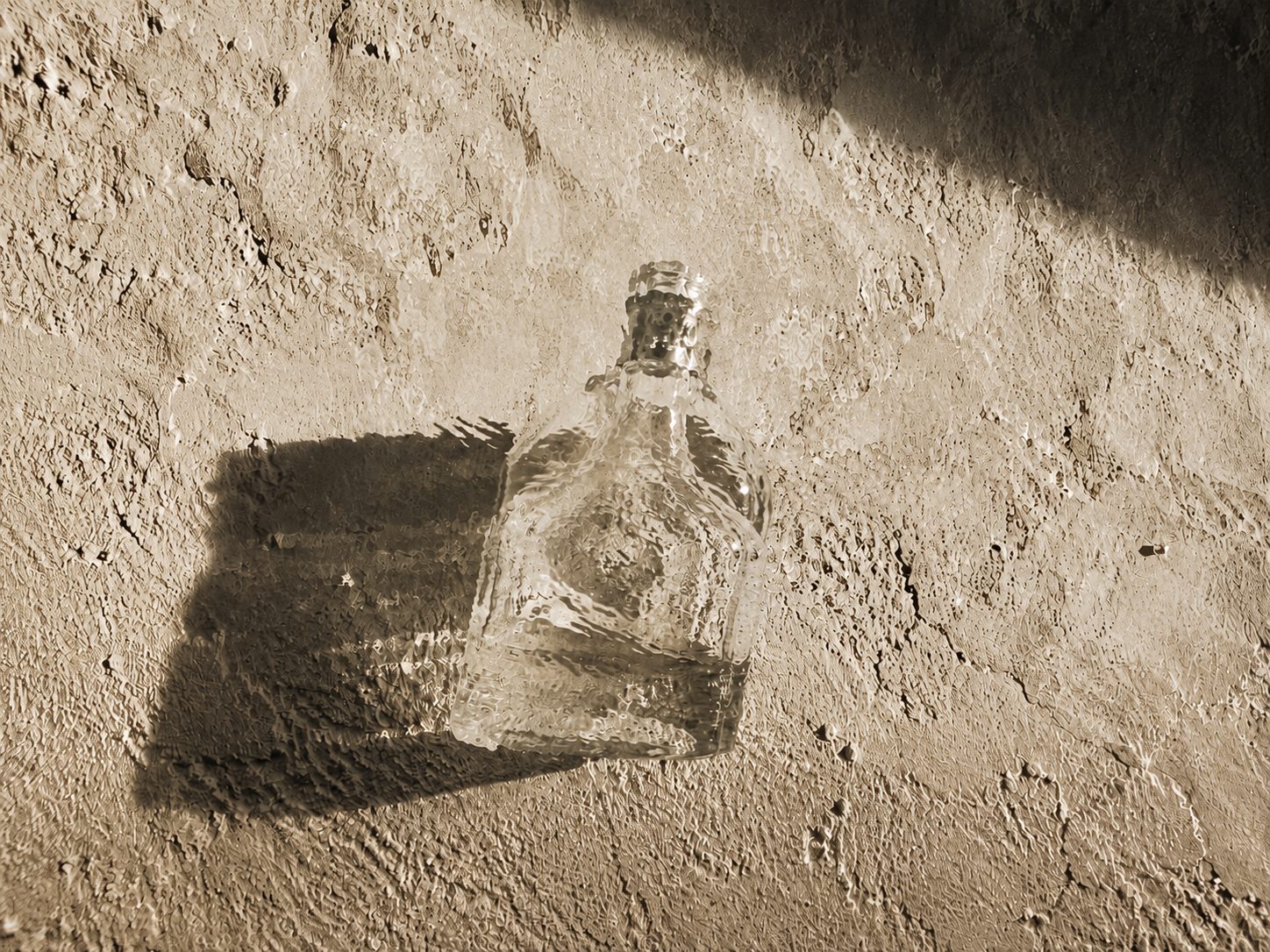
Humidity is more complicated than the usual advice suggests. There is no reliable universal rule that humid air automatically makes every perfume stronger or weaker. In one controlled study, temporary changes in ambient temperature and humidity did not significantly alter standard smell-test results in healthy participants under the tested conditions. The more useful question is not whether humidity changes your nose in one simple direction. It is how a humid climate changes the surface from which the fragrance is released. In warm, humid weather the applied film may encounter sweat, water, salts and skin lipids. Fragrance molecules differ in their affinity for water, oil and air. Studies of fragrance-like molecules in aqueous systems show that water can suppress the release of one material while accelerating another. That laboratory result is not a direct map of a wrist in Jeddah or Singapore, but it proves the important point: moisture does not turn the whole composition up or down together. It can rearrange the mixture.
02Your skin is part of the formula
A blotter is useful because it is comparatively stable. Skin is useful because it is real, and difficult because it is alive.
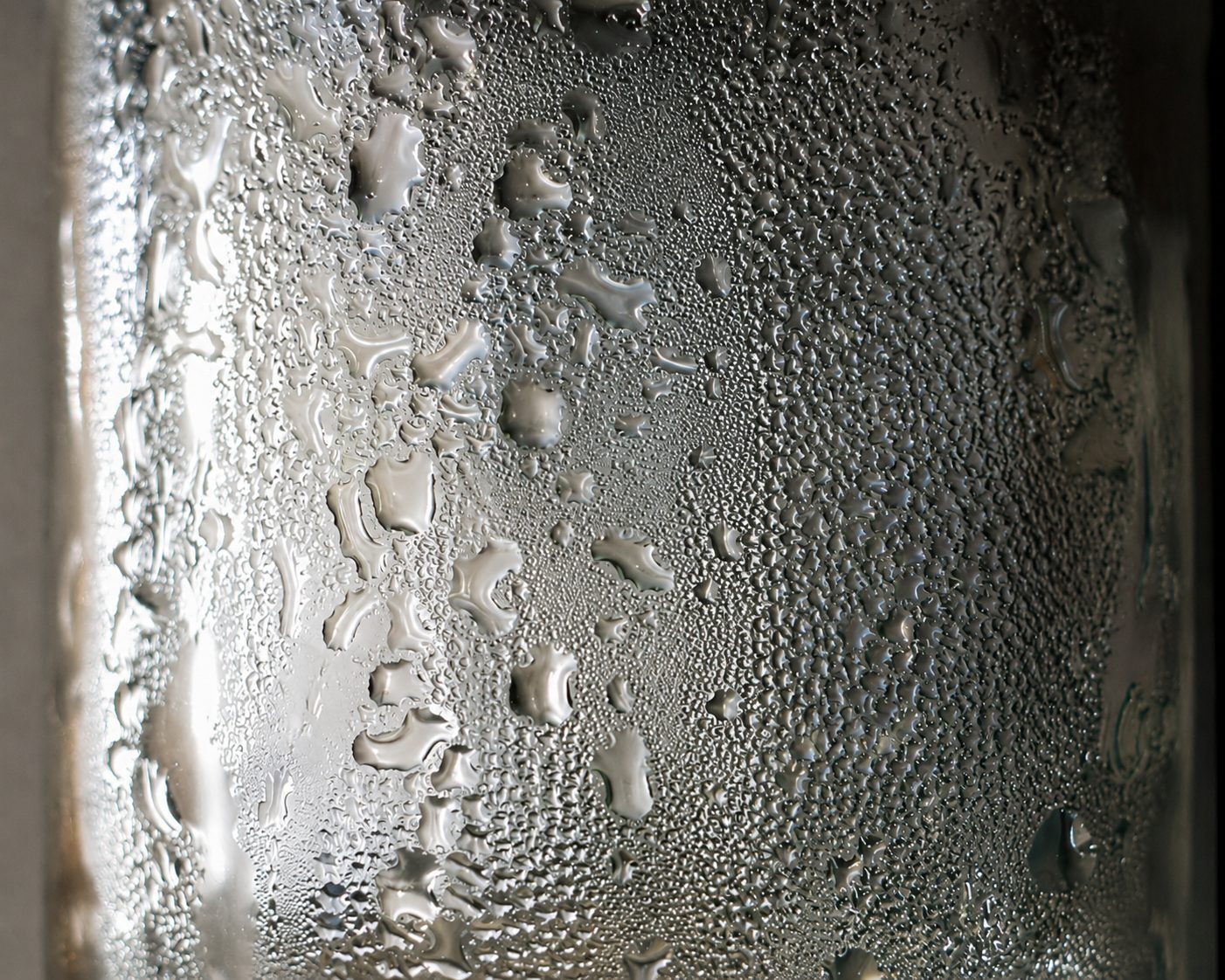
Fragrance studies on human skin have measured meaningful differences between people and between application surfaces. Skin can slow evaporation compared with an inert surface, and individual ingredients do not all respond in the same way. Recent work found that the evaporation profiles of a multi-material fragrance varied among volunteers, producing different airborne compositions over time. This is where body chemistry earns a precise meaning and loses some of its folklore. Skin temperature matters because release is temperature-dependent. Sebum matters because oily components can retain or partition some materials differently. Hydration, surface roughness, water loss through the skin and pH are measurable properties researchers examine when they try to explain variation. None of them alone is a magic key that tells you exactly how rose, oud or vanilla will smell on a person. The evidence supports interaction and variation, not the internet myth that one pH number converts every perfume into a different formula.
Cold asks a fragrance to speak up. Heat asks it to choose its words.
Sweat changes the scene again. On warm skin it can dilute the applied film, move it across the surface, add an aqueous phase and mix the perfume with a person's own volatile body odour. Research on perfume and body odour shows that the combined smell can retain qualities of both while creating an individually specific result. The practical consequence is that performance should be judged on the skin you will actually use, in the weather in which you will actually live. A test performed inside an aggressively air-conditioned boutique is not a complete test for an outdoor July evening. A wrist sprayed after a hot walk is not the same surface as a clean, cool forearm. Neither condition is false. They answer different questions.
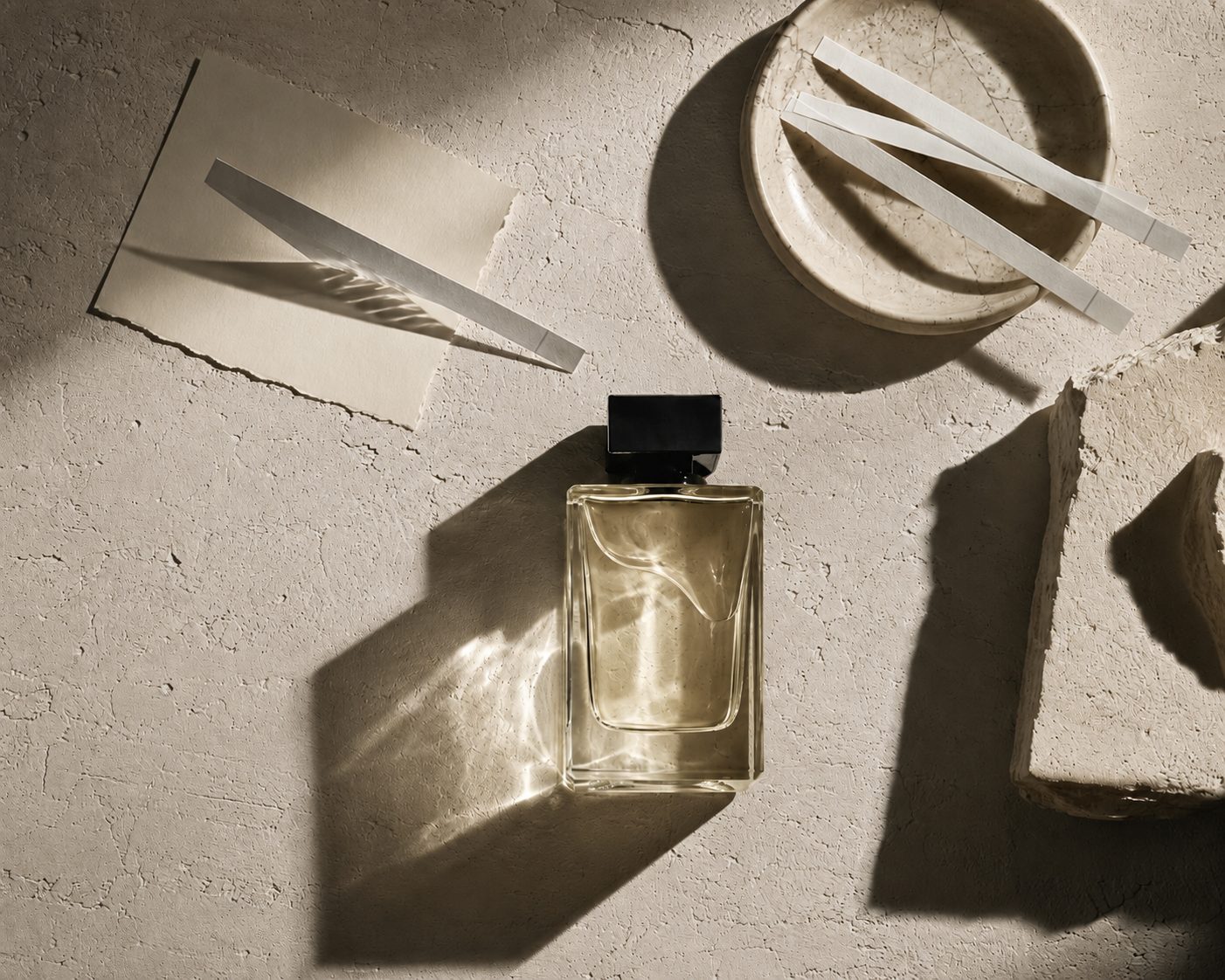
What tends to survive heat is not a list of fashionable notes. It is a well-constructed balance of diffusion and staying power. Lower-volatility materials, including many musks, woods, resinoid effects and amber materials, often provide persistence. Yet a formula built only for persistence can become dense, sweet or suffocating when heat increases its release. A composition built around very volatile materials can be exhilarating in heat but brief. Molecular weight alone does not decide the outcome. Vapour pressure, water and lipid solubility, odour threshold, concentration and mixture interactions all matter. For cold weather, a fragrance often benefits from materials that can still reach the air at lower temperatures, or from enough contrast in the opening to prevent the composition from feeling sealed. Rich bases can be beautiful in cold conditions because their slower evolution suits the air, but they still need lift. In heat, lift is rarely the problem. Control is.
03Buy for the weather you actually live in
When a perfumer is asked to tune performance for a hot market, the serious work is not adding more perfume until the formula shouts. It is reshaping the release curve. That may mean reducing or supporting materials that flash off too quickly, strengthening the bridge between the opening and the heart, selecting more substantive materials, changing the balance of solvent and water, or using low-odour carriers and fixative systems that slow evaporation without flattening diffusion. Patent literature and delivery-system research describe several ways to increase substantivity or create slower release, including polymeric carriers and encapsulation. These tools can extend presence, but they can also alter projection or character, so the formula has to be smelled again, not merely calculated.
The final step is testing under the intended conditions. A fragrance for a hot, dry city and one for a hot, humid coast may face the same temperature but a different skin film, sweat pattern, clothing behaviour and indoor-outdoor rhythm. The formula should be evaluated on skin, on blotter and, where relevant, on fabric, over time and at realistic temperatures.
For the buyer, the method can be simpler. Start with climate, not reputation. Choose the place where the bottle will spend most of its life, then ask what job it must do there. For a hot commute and an air-conditioned office, you may want brightness with a controlled drydown, not a huge sweet base that blooms in the car. For a humid evening, test whether florals, fruits and musks remain distinct after you begin to perspire. For a cold winter, give the fragrance longer to open and judge it beneath the clothing you will actually wear.
Use concentration as a clue, not a guarantee. A higher concentration can increase the amount of fragrant material applied, but longevity and projection still depend on the composition and its release. An eau de toilette with a disciplined structure may perform better in heat than a dense extrait that becomes exhausting. The label on the bottle does not replace a full wear. And test twice. First, spray on clean skin and leave the shop; do not decide from the first five minutes. Second, wear the sample through a normal day in your own climate, noting the opening at fifteen minutes, the centre at two hours, and what remains late in the day. If you are buying while travelling, take a sample home before buying the full bottle. That small delay is cheaper than discovering you purchased a memory rather than a fragrance.
Treating climate as a structured part of choosing changes the practical answer, which is why it deserves to sit beside family, notes, concentration and season rather than being left to chance. One honest caution belongs here. A catalogue can carry far more fragrances tagged for dry or mild conditions than for hot ones, and that gap usually reflects incomplete tagging rather than a real shortage of perfumes suited to heat. It should be read as a limit of the labels, not as evidence about the perfumes. Use climate as a first narrowing tool, then cross it with the way you live. Climate cannot promise that you will love a perfume. It can prevent you from asking the wrong bottle to do the wrong job.
The fragrance you loved abroad was not lying. It was speaking the language of that air. The useful question is not which version is the real one. Both are real. The better question is, where do I need this fragrance to become itself?
Analysis drew on the Osmagora fragrance library.
Teixeira et al., Perfume Engineering: Design, Performance & Classification, Elsevier, 2013.
Saiyasombati & Kasting, 'Two-stage kinetic analysis of fragrance evaporation and absorption from skin', Int. J. Cosmetic Science, 2003; Vuilleumier, Flament & Sauvegrain, 1995.
Drews et al., 'The sense of smell is not strongly affected by ambient temperature and humidity', Eur. Arch. Oto-Rhino-Laryngology, 2021.
Danov et al., Colloids and Surfaces A, 2021; Hadjiefstathiou et al., Int. J. Cosmetic Science, 2025.
Lenochová et al., 'Psychology of fragrance use', PLOS ONE, 2012; Kasting, Int. J. Cosmetic Science, 2001.