Sillage, projection and longevity: the words people get wrong
A perfume can announce itself from three desks away, leave almost no trail when you walk, and stay on a cuff until tomorrow. Another can bloom around you for twenty minutes, follow you down a corridor, then vanish before lunch. Both will be described online as strong. That word is doing far too much work.
I am not a perfumer. I am a collector who has spent years spraying wrists, sleeves and blotters, then checking them at increasingly antisocial intervals. The useful lesson is not that fragrance performance is unknowable. It is that performance has parts. Learn three words precisely and the reviews suddenly become readable.
The short version. Sillage is the trail you leave behind you when you move. Projection is how far the scent reaches from you while you stand still. Longevity is how long it survives on a stated surface. They overlap, but they are not the same thing, and no single word covers all three.
01The wake, the reach, the clock
Sillage is the trail a fragrance leaves behind a moving wearer. The word is French. Its older meaning is the wake left by a boat on water, and French dictionaries apply it to the odour left behind by a perfume too. Picture someone crossing a lobby. The scent that hangs briefly along the route they took is sillage. It is a wake, not a force field.
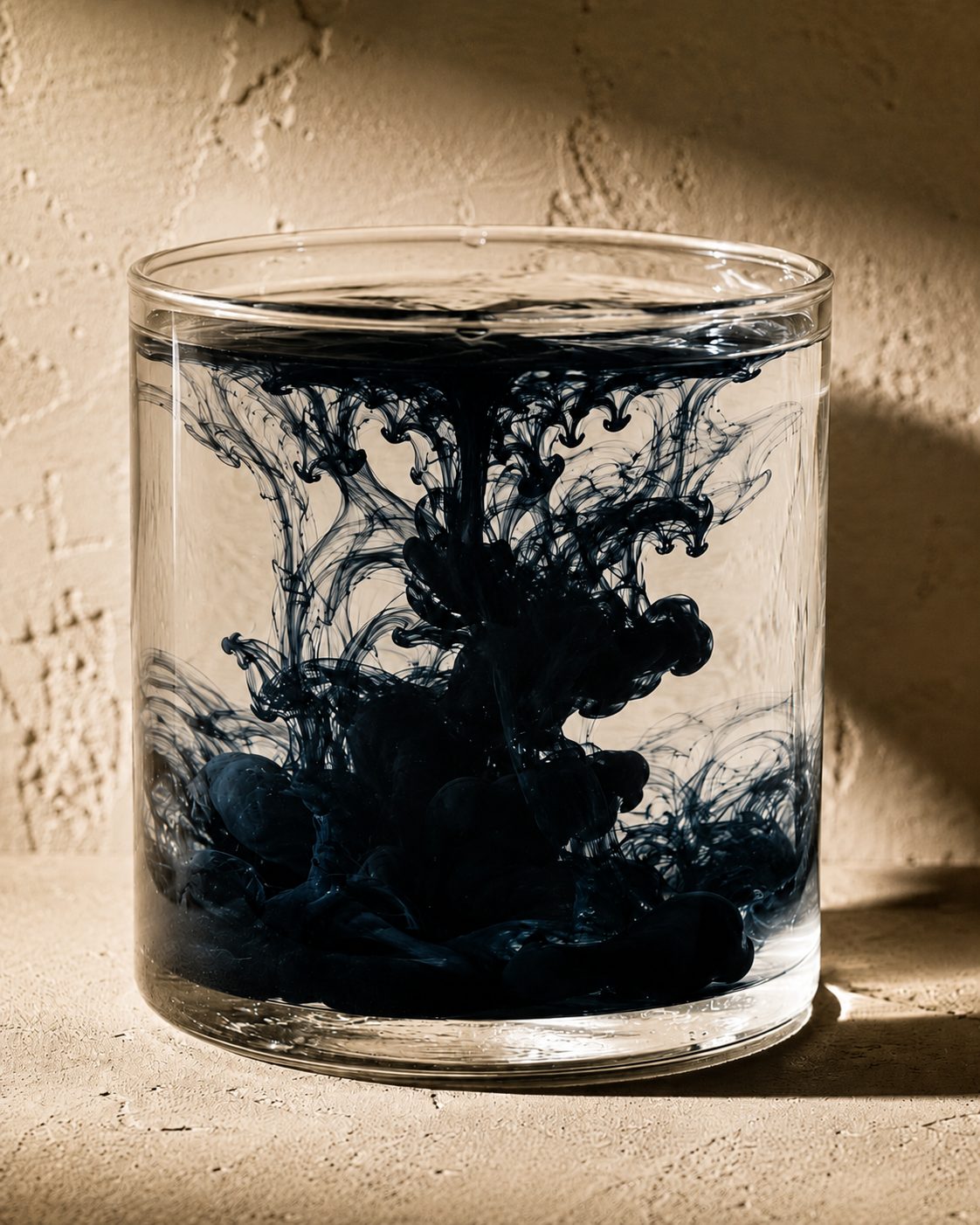
Projection is how far the fragrance reaches from the wearer at a given moment. It answers a simple question: how close does another person have to be to smell it right now? Projection usually shifts through the wear. A bright opening may reach across a table, then draw inward after an hour. Another perfume begins quietly and grows a broader presence as warmer, more diffusive materials wake up.
Longevity is how long the fragrance stays detectable on a stated surface, and the surface matters enormously. Eight hours on a wool cuff is not eight hours on skin. Detectable does not mean projecting, either. A perfume can survive as a faint skin scent long after it has stopped reaching anyone more than an inch away. Calling that eight hours of beast mode is how reviews become folklore.
A trail is not a radius. A radius is not a lifespan.
The three behaviours can combine in any order. A fragrance may project strongly while you sit still and yet leave a modest trail, because its most noticeable materials fade fast. It may throw beautiful sillage in motion and then sit close when you stop. It may last all day at a restrained radius. None of these is a flaw. They are simply different shapes of presence.
02Why the bottle cannot promise the result
To smell a perfume, part of it has to enter the air, and the materials in a formula do not leave the skin at one obedient speed. Researchers who study performance use headspace measurements precisely because individual odorants diffuse and evaporate differently, and because their behaviour changes when they are mixed, placed in another base, or laid on a different surface.
So longevity is not a countdown printed invisibly on the bottle. Studies of evaporation from skin have found different release rates between ingredients, and shown that interactions within a mixture alter those rates again. More recent work followed volunteers directly and found that both molecular properties and differences in skin help explain the variation. Skin is not neutral glass. Hydration, surface lipids, pH, temperature and whatever you applied it with are all part of the result.

Air changes the performance too. Temperature, humidity and airflow are controlled in release experiments because they affect drying and transport and what reaches the surrounding air. In ordinary life, a cool office, a humid pavement and a hot car are three different test chambers. The same perfume can feel expansive in one, compressed in another, and abruptly short-lived in a third.
Concentration tells you how much formula is present. It does not tell you how that formula will behave.
Clothing adds another timeline. Textile research shows retention varies with fibre, weave and density. In one controlled study, fabrics with more cotton held fragrance better than those with more polyester, and twill held it longer than plain weave under the conditions tested. That does not crown every cotton shirt over every synthetic jacket. It means lasted on clothes is incomplete until the clothes are named.
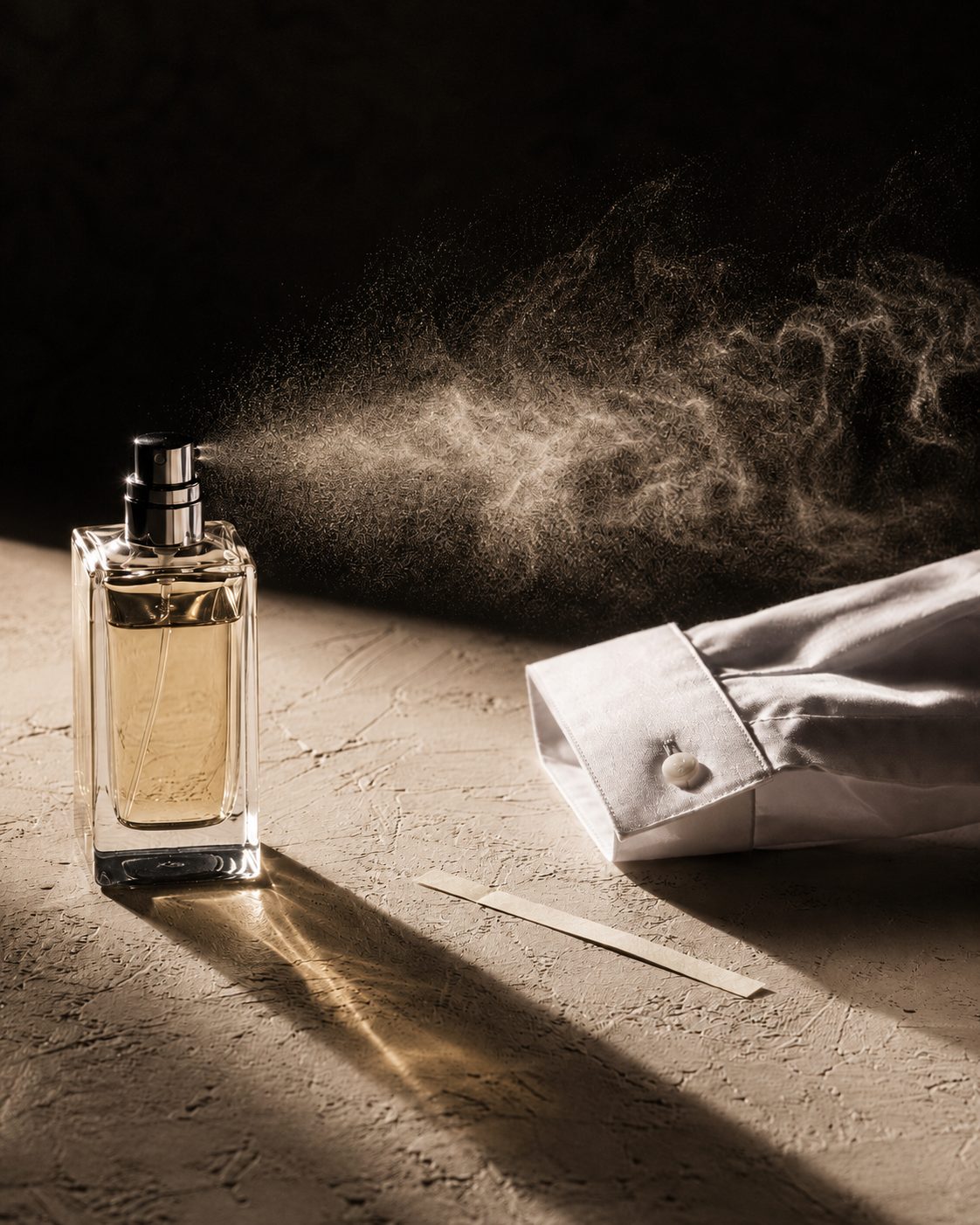
Concentration is useful and weaker than people think. The International Fragrance Association is blunt that terms like eau de cologne, eau de toilette and eau de parfum are general descriptors, not strict international standards, and that usage varies by market. More concentrate can change richness, diffusion and persistence, but there is no law making every eau de parfum louder or longer than every eau de toilette. A lower-concentration formula built from persistent, high-impact materials can outlast a denser one designed to sit close.
Which brings me to the badge on the box. Eau de parfum has become the default label, printed on well over half of what is released now. A default is handy for shelving and increasingly weak as a prediction of behaviour. A percentage tells you how much fragrance compound is present. It does not tell you what that compound contains, or how the finished thing releases.
03How to test without lying to yourself
The honest test is not glamorous. It needs the same dose, a known surface, and a clock. It also needs you to accept that your own nose becomes a poor witness while you are sitting inside the scent all day. Research on habituation shows perceived intensity falls with prolonged exposure, which is exactly why a colleague still smells your perfume long after you decided it had gone.
Test longevity first. On a normal day, apply one measured spray to one forearm and note the time. Use your ordinary skin routine, because the point is to learn how the fragrance behaves in your life, not on an imaginary laboratory version of you. Check at thirty minutes, two hours, four hours, and later in the day. At each check, ask whether it is clearly detectable at conversational distance, detectable only close to the skin, or gone. That separates survival from reach.
Test projection on another day with the same dose and placement. Ask one trusted person to assess it at a few ordinary distances: beside you, across a small table, and at the far side of a room. Repeat early, mid-wear and late. Do not ask, is it strong? Ask, from where can you smell it? The second question produces information. The first produces politeness.
Test sillage by moving. Walk past your observer at a normal pace, then leave the room for a moment. Ask whether the fragrance was noticed before you arrived, as you passed, or briefly after you had gone. That last answer is the trail. A wrist pressed under someone's nose cannot test sillage. It tests their patience.
If you wear fragrance on clothing, repeat the exercise once on fabric, but name the fabric and keep that dose separate from the skin test. Do not combine four sprays on a sweater with two on the neck and then announce that the perfume itself lasts fourteen hours. You have tested a wearing system, which is genuinely useful, but it is not the same claim.
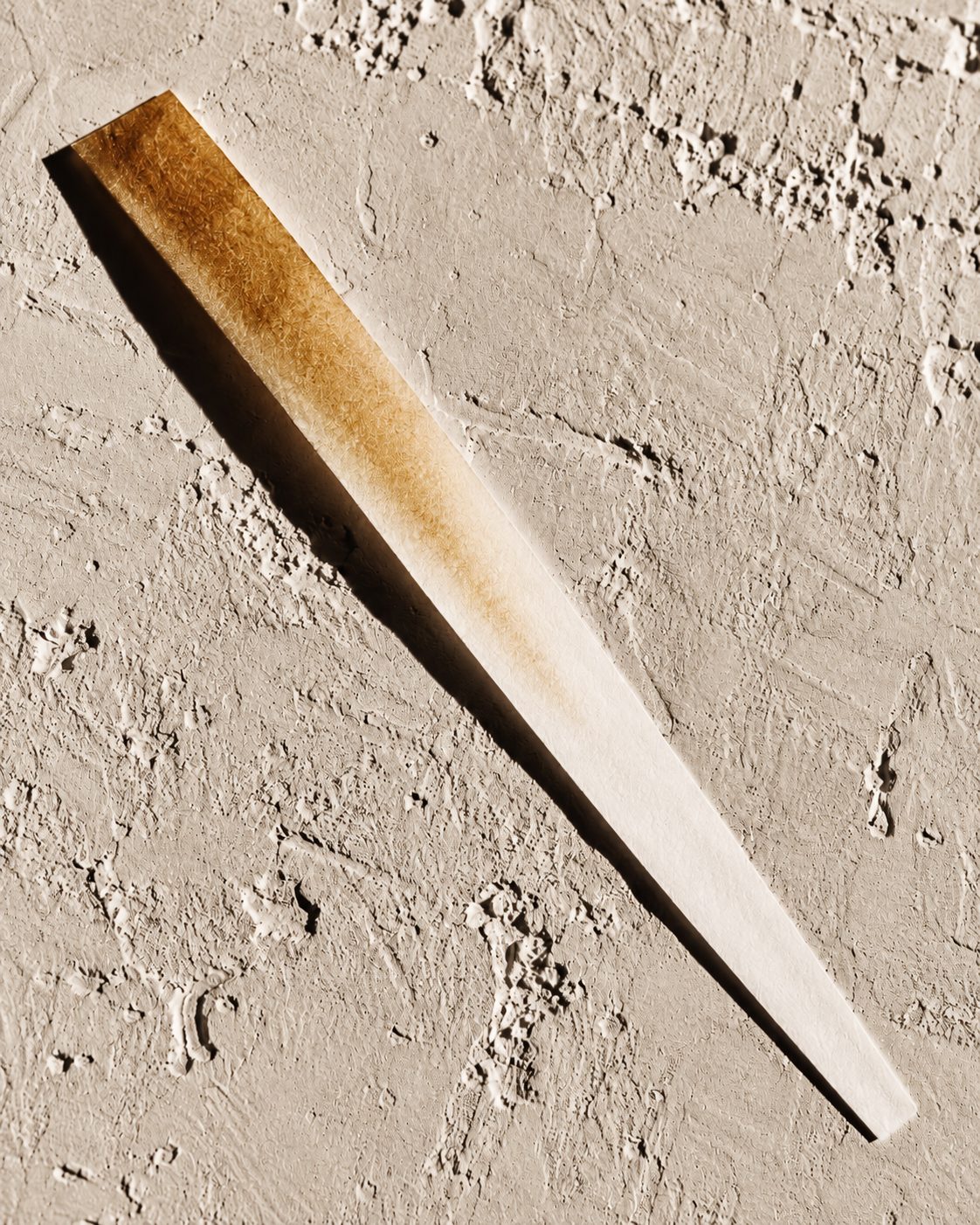
For an office, the reading that matters most is usually the first two hours at your real dose. You want to know whether it reaches beyond normal conversation, whether it leaves a trail through shared corridors, and how fast it settles. An office fragrance does not need to disappear. It needs to become legible at the right distance, rather than arriving before you do.
Read reviews with the same discipline. Look for dose, placement, climate, season, surface, elapsed time, and whether another person confirmed the result. A review with none of those can still be sincere, but it is autobiography, not measurement. And watch the language of the arms race. Beast mode may mean two sprays in summer. Skin scent may mean the wearer adapted after twenty minutes. Compliment magnet may mean one friend was asked three times. None of it makes the reviewer dishonest. It makes the missing conditions important.
Keep the formula in your head. Sillage is the wake. Projection is the reach. Longevity is the clock. Separate those three and reviews become readable, office choices become easier, and a perfume no longer has to shout all day to be called good.
Analysis drew on the Osmagora fragrance library.
Larousse and CNRTL, French dictionary definitions of 'sillage'.
Stora, Escher and Morris, 'The Physicochemical Basis of Perfume Performance in Consumer Products', Chimia, 2001.
Vuilleumier et al., headspace study of perfume ingredient evaporation from skin, 1995; Saiyasombati and Kasting, 2003.
Hadjiefstathiou et al., fragrance evaporation and skin properties, International Journal of Cosmetic Science, 2025.
Du et al., 'Effect of Fabric Parameters on Fragrance Retention', Industria Textila, 2020.
International Fragrance Association, 'Using the Standards' (concentration descriptors).
Pellegrino, Sinding, de Wijk and Hummel, 'Habituation and Adaptation to Odors in Humans', Physiology & Behavior, 2017.